Lessons in the Art of Poetry, Drew MFA First Residency Jan 2009

I enjoy seeing naughtiness done in strict iambic pentameter. Alicia Ostriker

Earnest dictates want us to remove the heart and frontal lobe from lyric poetry [but] the need for a lone voice to sing out of the darkness will go on. Joan Larkin

Well, we certainly can’t have the word “love” in a poem. Martin Espada

Art is a series of answers to which there are no questions. C.K. Williams

The poem becomes a vehicle for pinning down moral dilemma.
C.K. Williams

As a poet I’m always concerned about history, and about bearing witness to history. Natasha Terthewey, in an interview on NPR while drafting my residency essay

A poem should surprise truthfully. Martin Espada

Punctuation is your friend. Martin Espada

A phrase in parentheses is a poet’s cry for help, “I don’t know why I’m saying this!” Martin Espada

You can use anything you want – it’s liberty hall.
Jean Valentine

Whenever you have a block, there’s something under the rock.
Alicia Ostriker

Poetry does make something happen, for it changes sensibility.
Robert Hayden

A poem is built on silences as well as on sounds. And it imposes a silence audible as a laugh, a sigh, a groan. Robert Hayden

Dickinson’s poems often have guillotine endings – the poem has its head chopped off.
Anne Marie Macari

The last line of the poem should automatically make the eye bounce back to the beginning to start over. Martin Espada

I like the white hot moment of silence at the end of a poem. Patricia Smith

You must write better than you consciously know – the bulk of your work gets done by your unconscious mind. Alicia Ostriker

Using the language of speech is what distinguishes American poetry from other poetry or Don’t use book words without a reason. spoken in some variation by Alicia Ostriker, Gerald Stern, Anne Marie Macari, and C.K. Williams

a poem for a quiet winter Monday, dreaming of summer and easy love

pollinator
Susan Windle

heading for the scent
of what i love
i land
on a wetness
that sends me
tumbling
to the bottom
of your cup

though i slip,
though i stumble,
though i bear heavy,
bewildered wings,
i find in you
a slender door
i narrow myself
through
your needle’s eye
the walls of your world,
soft and supple,
push me on
to that sliver of light—
where day
breaks over me at last

i am coated
in the fragrance of such love
i go
with good news
on my back

click here for

Wednesday morning

My last day here, and I’m finding it hard pondering my return to being an ordinary person, not a full-time poet.

And the mess in Gaza just gets more and more awful.

And my job started laying people over yesterday, in large part because our multi-year well-funded Wachovia project is as dead as Wachovia itself.

But poetry is one kind of magic — marks on a page take us into other times, other minds, other possibilities. So this, from poet Gerald Stern.

Bee Balm

Today I’m sticking a shovel in the ground
and digging up the little green patch
between the hosta and the fringe bleeding heart.
I am going to plant bee balm there
and a few little pansies till the roots take
and the leaves spread out in both directions.

This is so the hummingbird will rage
outside my fireplace window; this is so
I can watch him standing in the sun
and hold him a little above my straining back,
so I can reach my own face up to his
and let him drink the sugar from my lips.

This is so I can lie down on the couch
beside the sea horse and the glass elephant,
so I can touch the cold wall above me
and let the yellow light go through me,
so I can last the rest of the summer on thought,
so I can live by secrecy and sorrow.

Monday evening

So I could have been in an optional workshop now, and I did plan to go, but I needed quiet, needed to check in with the world via some online news, and to just be in my own space.

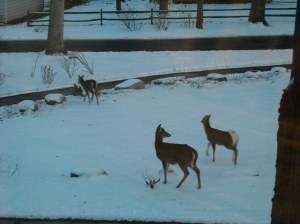
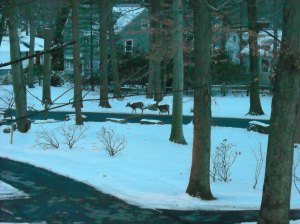
The world rewarded my sloth with a visit from a herd of deer, first two, then another, then another, then another, then another, right outside my window. I wish had a picture of the deer staring as a group of runners plodded past, but dark was coming on, and using a flash produces what might be art but is definitely not representation.

Now, off to dinner, then a short cello recital by the intern who is helping our program and also happens to be a wonderful musician and composer. Then a poetry reading. Then a reception. Then back to the dorm to study the poems for tomorrow morning’s workshop. And so it goes.2-deera 3rda 4tha 5tha 6th

C.K Williams on translating

from a Thursday lecture on the triumphs and tribulations of translating

-poetry is itself a language
-poetry can only be translated into poetry
-poetry is the gap between what you know and what you do

We are, he said, mainly unconscious of how much translation has functioned in our history and culture. The Renaissance was heavily works translated from Greek and Rome, for example, and U.S. poetry was rescued from strangling formalism in the 1950s by translations that poured into the country from Latin and South America and Europe.

Bishop — “translating poetry is like trying to put your feet into gloves.”

Always an issue of form vs. content — do you translate the meaning, the poetic vision, the meter, the rhyme? Try for some kind of hybrid? Poetry is music and lyrics, and compromises must always be made.

There are levels of translations — literal, free, translation of the vision by choosing new words and images from the second language. Then there are “versions,” where the translator doesn’t even pretend to convey the work of the original poet, but to make new poems out of the old. “Grand theft auto translation” he called this latter, “past the edge of where translation can go.”

He is now considering “thick translations,” where the poem is translated but then followed by pages of commentary explaining how and why it worked in its original language and what choices the translator made.

Most translated poems are shared work, between someone fluent in the first language and a poet skilled in the second language.

Transfiguring is also a possibility, shifting art in to poetry, poetry to dance, etc — this is a kind of shape-shifting as opposed to translating between languages.

And lest anyone think we all sit around politely reciting verse, here’s C.K.’s comment on one translation, ” It had nothing whatsoever to do with the original and furthermore is just crap.”

Notes on Paul Celan and translating

from a lecture on Saturday by Mihaela Moscaliuc

Paul Celan was a Jewish writer and Holocaust survivor whose family was killed as first the Soviets and then the Germans occupied his land. He grew up in what was then Romania, speaking German at home, later Russian and Romanian in school. His parents were deported in 1942, and later he was sent to a labor camp. After he was liberated from the camp, he ended up in Paris, trying to use writing to reflect the horror and the loss, and, I think, to save himself. He wrote poems still very highly regarded by critics, that have been translated in to many languages. But, like so many other survivors, the crushing weight of the violence was unbearable, and he eventually took his own life. Celan wrote in German, even though he spoke 8 languages, because it was, he said, the only language that he could write poetry in, but German haunted him at the same time.

All of which is background to what really interested me – the discussion about languages, history, trauma, and meaning. Mihaela described Celan’s German as “a language informed by history.” That is, Celan could not write in German without simultaneously knowing that his mother’s killers spoke to her in German before her murder. In Celan, she said, we have intra-lingual translation — two different Germans, the formal, literary German he learned as a child, and the traumatized German he wrote in as an adult, and that in profound ways these are different languages. Consequently, his poems are really tricky to translate, because he stretches and warps the language, trying to make meaning from the horror and emptiness. She described one critic who said of Celan, “words are inscribed into his poems like wounds.”

Words inscribed like wounds — this is such an accurate description of so many other writers, too. I’m thinking of Gloria Anzuldua, Sylvia Plath, some of Adrienne Rich, so many lesbian poets and so much writing about violence against women. And having to stretch and warp our own language because it cannot convey what has happened to us.

One of my poet cohorts, Monica, says of herself that English is her second language, but she hasn’t yet remembered her first. Which is the point of the saying, made trite as it became a t-shirt slogan, “I speak patriarchy, but it isn’t my mother tongue.”

I have only one language — what are the ways it can’t convey what my life has meant?

Celan had 8 languages, and still struggled with a horror too big for all of them.

This is where poetry is the revolution, because we shape language, and ride it when we can’t grasp it enough to shape it.

Paul Celan

Paul Celan

Notes on Dickinson, Poetry and Language

from our afternoon lecture by Anne Marie Macari

-language is hypothesis and experiment
-poetic language expands our boundaries
-metaphor is instinctual groping

Dickinson’s definition of “redemption” is those things that force us into immediate experience, to the embodied, physical realm

Dickinson would improvise for hours on the keyboard, and was a singer with perfect pitch — no surprise that her poems are strong musical compositions, with lines of harmony and dissonance, and cannot be understood aside from this. The rhythm, the pacing — you have to pay attention to these, for they can change and shape the “surface” meaning of the words.

In many of Dickinson’s poems, she casts herself as a rival to God as a creator (Surprised? That whole “lonely spinister of Amhearst” crap has so limited how most of us understand Emily)

The male critics who spend all their time searching for men in Dickinson’s life, limited by their assumption that some man somewhere has to be connected to such creative brilliance, have “Dickinson Envy,” Anne Marie says.

Dickinson has, in the words of one biographer exploring gender politics, “a power disembodied from its user.” Dickinson claims so much power in her poetic voice, challenging religion, god, men, but at the same time is distant from that power. No surprise, given when she lived. Rich’s essay on this in On Lies, Secrets and Silences comments that, in a masculine-assumptive world, “active willing and creation in women are forms of aggression.”

Anne Marie talked about the often astounding endings of Dickinson’s poems, lines that turn the poem, and often social order, inside out. She described these as “guillotine endings” — the poem has its head chopped off. Martin Espada, in a workshop, talked about creating poems where the last line automatically makes the eye bounce back to the beginning to start over. That made total sense to me, but the endings that crack open the world also appeal to me – such different ideas, such different poems.

A Dickinson poem I didn’t know:

#301
I reason, Earth is short-
and Anguish- absolute-
And many hurt,
But, what of that?

I reason, we could die-
The best Vitality
Cannot excel Decay,
But, what of that?

I reason, that in Heaven-
Somehow, it will be even-
Some new Equation, given-
But, what of that?

Anne Marie Macari

Anne Marie Macari

Sunday morning

Snow falling on poetry students. It’s beautiful here now, white everywhere, and the way a landscape is so quiet on the morning after snow. The pictures are out my dorm room / monastic cell window.

Last night the poets partied, in a poet kind of way, appropriating a lounge, wickedly violating the “no open bottles in public spaces” rule, reading each other our work, careening from tear-streaming laughter to tears. Two of the Southerners sang “Folsom Prison Blues,” including the guitar licks, the lesbians (many of us, it turns out), played “Six Degrees of Separation” focused on Rachel Maddow, the red wine and craft-brewed beer flowed, and a wonderful “Oh body, oooooh baby!” poem from that morning’s workshop was performed with a full back-up chorus. Kim captured the entire extravaganza on video, which I may either share or suppress, depending. Check in the links to the right for the Picasa album.

This morning I’m being quiet, happily so, reading and thinking and preparing for my meeting at 1 with poet-in-residence Gerald Stern — he’s won every award, has a shelf full of books, and is kind and warm and funny as hell. Then I meet with Alicia to firm up my study plan for the next four months, then a faculty lecture by Anne Marie Macari on Harmony and Dissonance in Emily Dickinson. Then another long evening off, which I definitely need. All this being social and “on” all day is too much for my hermit-self.

Some friendly advice — when traveling, avoid whichever continent “continental breakfast” represents. Really. You just don’t want to go there.

dscn0594