new work is up

Too many beers (2, actually, but that seems to be 1 too many), too much busy head after dinner with ex-coworkers, awake in the middle of the night, trying to work on something serious about Cain or Lot’s wife, and this is what I get — Marlena “Doc” Evans Brady Black. Check it out on the right.

a poem for a quiet winter Monday, dreaming of summer and easy love

pollinator
Susan Windle

heading for the scent
of what i love
i land
on a wetness
that sends me
tumbling
to the bottom
of your cup

though i slip,
though i stumble,
though i bear heavy,
bewildered wings,
i find in you
a slender door
i narrow myself
through
your needle’s eye
the walls of your world,
soft and supple,
push me on
to that sliver of light—
where day
breaks over me at last

i am coated
in the fragrance of such love
i go
with good news
on my back

click here for

Oy, such a Friday and Neko Case

So, after ten years, I was laid off today — my agency is hurting financially, and they decided not to do what I do anymore.

Oy.

Can’t really bear to say much more about that.

In better news, Neko Case has released the first single from her new album, out in March. Download it via this link below. And if you blog, post it so your blog! Every post is a $5.00 donation to the amazing Best Friends Animal Shelter.

The song:

Wednesday morning

My last day here, and I’m finding it hard pondering my return to being an ordinary person, not a full-time poet.

And the mess in Gaza just gets more and more awful.

And my job started laying people over yesterday, in large part because our multi-year well-funded Wachovia project is as dead as Wachovia itself.

But poetry is one kind of magic — marks on a page take us into other times, other minds, other possibilities. So this, from poet Gerald Stern.

Bee Balm

Today I’m sticking a shovel in the ground
and digging up the little green patch
between the hosta and the fringe bleeding heart.
I am going to plant bee balm there
and a few little pansies till the roots take
and the leaves spread out in both directions.

This is so the hummingbird will rage
outside my fireplace window; this is so
I can watch him standing in the sun
and hold him a little above my straining back,
so I can reach my own face up to his
and let him drink the sugar from my lips.

This is so I can lie down on the couch
beside the sea horse and the glass elephant,
so I can touch the cold wall above me
and let the yellow light go through me,
so I can last the rest of the summer on thought,
so I can live by secrecy and sorrow.

bees and billiards and blooms

more bees, this time from my friend Carol Burbank. You can find the entire poem to the right, under “Guest Poets”

then there must be something to tell
in all the silence
of the bees and billiards and blooms
that make the day hum and click

Monday evening

So I could have been in an optional workshop now, and I did plan to go, but I needed quiet, needed to check in with the world via some online news, and to just be in my own space.

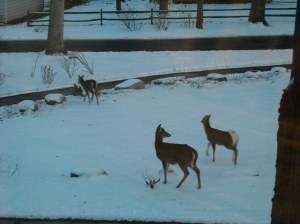
The world rewarded my sloth with a visit from a herd of deer, first two, then another, then another, then another, then another, right outside my window. I wish had a picture of the deer staring as a group of runners plodded past, but dark was coming on, and using a flash produces what might be art but is definitely not representation.

Now, off to dinner, then a short cello recital by the intern who is helping our program and also happens to be a wonderful musician and composer. Then a poetry reading. Then a reception. Then back to the dorm to study the poems for tomorrow morning’s workshop. And so it goes.2-deera 3rda 4tha 5tha 6th

C.K Williams on translating

from a Thursday lecture on the triumphs and tribulations of translating

-poetry is itself a language
-poetry can only be translated into poetry
-poetry is the gap between what you know and what you do

We are, he said, mainly unconscious of how much translation has functioned in our history and culture. The Renaissance was heavily works translated from Greek and Rome, for example, and U.S. poetry was rescued from strangling formalism in the 1950s by translations that poured into the country from Latin and South America and Europe.

Bishop — “translating poetry is like trying to put your feet into gloves.”

Always an issue of form vs. content — do you translate the meaning, the poetic vision, the meter, the rhyme? Try for some kind of hybrid? Poetry is music and lyrics, and compromises must always be made.

There are levels of translations — literal, free, translation of the vision by choosing new words and images from the second language. Then there are “versions,” where the translator doesn’t even pretend to convey the work of the original poet, but to make new poems out of the old. “Grand theft auto translation” he called this latter, “past the edge of where translation can go.”

He is now considering “thick translations,” where the poem is translated but then followed by pages of commentary explaining how and why it worked in its original language and what choices the translator made.

Most translated poems are shared work, between someone fluent in the first language and a poet skilled in the second language.

Transfiguring is also a possibility, shifting art in to poetry, poetry to dance, etc — this is a kind of shape-shifting as opposed to translating between languages.

And lest anyone think we all sit around politely reciting verse, here’s C.K.’s comment on one translation, ” It had nothing whatsoever to do with the original and furthermore is just crap.”